Sponsored By:
Policy is already moving markets in 2026 — trade enforcement, regulatory shifts, and tax positioning are redirecting capital right now. Institutions reposition before the headlines catch up, and the window to act early is closing fast.
Our analysts identified 5 stocks showing real momentum tied directly to current administration policy themes — including the sectors benefiting most from domestic investment trends and regulatory tailwinds. Don't get left behind.
Get the Free Report Now(By following any of the links above, you're choosing to opt in to receive insightful updates from The Investment News Daily + 2 free bonus subscriptions! Your privacy is important to us. You can unsubscribe anytime. See our privacy policy for details.)

Monday, July 6, 2026 — Five moves that explain today: a governance handoff in Gaza, reassurance on NYC water safety, a White House-to-Wall Street promo, a rare Microsoft slide, and a $19B bet on AI infrastructure.
Image via Associated Press
Hamas says it’s stepping aside in Gaza—on paper, at least
Hamas said it has dissolved its government structure in the Gaza Strip and will transfer administrative authority to a UN-backed committee, signaling a bid to reframe who is responsible for day-to-day governance as the war grinds on. The announcement was delivered by Ismail al-Thawabta, a senior official in the Hamas-run government media apparatus, at a press conference in central Gaza.
The practical question is whether this is a real shift of control or a tactical rebranding that moves liabilities—humanitarian management, public services, and reconstruction logistics—onto an international umbrella. If a committee actually takes the keys, it could change the diplomatic lane for aid distribution and post-war planning, and it could also become the first test of whether any “day after” governance can function without immediate security guarantees.
Israel and key donors will watch for two things: who controls territory and weapons, and who can reliably coordinate humanitarian access without diversion. This move may lower the political temperature for some outside actors to engage, but it does not by itself answer the core issue of security and enforcement on the ground.
Read the full story at Associated Press →

Image via Washington Examiner
NYC says your water is safe after Legionnaires’ cases spiked
New York City officials said municipal water systems remain safe for drinking and showering following an outbreak of Legionnaires’ disease, aiming to tamp down fears that routine water use could put residents at risk. The city health department emphasized that the outbreak response has focused on identifying and addressing likely contamination points tied to building systems rather than the broader public supply.
Legionnaires’ is typically linked to inhaling aerosolized water droplets from sources like cooling towers, hot tubs, decorative fountains, or large building plumbing—not from drinking water itself. Public-health playbooks here are straightforward but urgent: trace likely sources, test and remediate facilities, and communicate clearly to prevent panic while still pushing at-risk people (older adults, smokers, those with chronic lung disease) to seek care early.
The next signal to watch is whether investigators identify a specific building-related source and whether enforcement follows—because the real risk lever in these outbreaks is compliance on maintenance, not consumer behavior at the tap.
Read the full story at Washington Examiner →
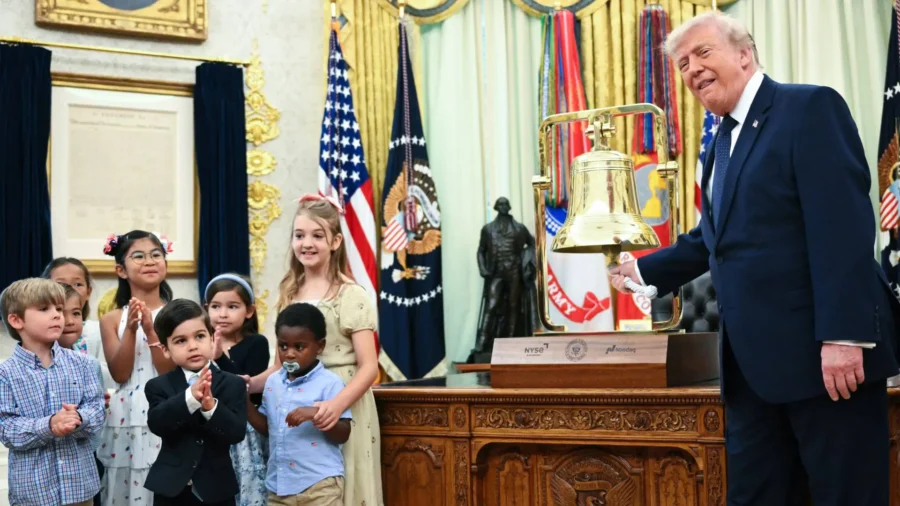
Image via NTD
Trump turns the opening bell into a product launch
President Donald Trump hosted an opening-bell ceremony tied to the rollout of “Trump” investment accounts, using a Wall Street ritual to spotlight a new financial offering. The event blended political branding with market symbolism, positioning the accounts as a consumer-facing product with the president’s name and promotional push.
Whatever the fine print, the broader point is the continued normalization of politics-as-brand extension: the presidency as a platform that can amplify private-sector products and affiliated ecosystems. That raises immediate questions about governance optics, potential conflicts, and how financial regulators treat marketing claims and disclosures when the pitch is inseparable from a public officeholder’s megaphone.
What to watch next: the account structure (fees, custody, underlying products), who runs distribution and compliance, and whether watchdogs or lawmakers push for clearer separation lines between official events and commercial promotion.

Image via Investing.com
Microsoft slips: big stock, big expectations, little patience
Microsoft shares slid today, a reminder that even “can’t-miss” mega-caps can get clipped when expectations are high and positioning is crowded. Investing.com pointed to market-driven pressure typical of the current tape: valuation sensitivity, rotation within large-cap tech, and investor scrutiny over the cost curve of the AI buildout.
In this environment, the market often treats Microsoft less like a company and more like a macro instrument—moving on rate expectations, index flows, and any hint that cloud growth or AI monetization timelines may not perfectly match the hype cycle. When the stock is priced for near-flawless execution, ordinary uncertainty reads like bad news.
Watch for follow-through in analyst notes and options flows: if the dip is mostly technical and flow-driven, it can snap back fast; if it coincides with revised expectations around cloud margins or AI capex, it can linger.
Read the full story at Investing.com →

Image via MarketWatch
TeraWulf jumps on a $19B Anthropic deal—and on the AI power rush
TeraWulf stock surged after news of a $19 billion deal with AI company Anthropic, a headline-sized endorsement of TeraWulf’s push beyond pure crypto mining and into powering AI infrastructure. The company’s CEO said the agreement “validates” its pivot, underscoring how energy access and data-center capacity have become the new scarce commodities in AI.
This is the clearest market signal yet that some “crypto infrastructure” players can re-rate if they convert their core advantage—sites, power contracts, grid relationships—into reliable compute support. But the gap between announcement and durable earnings remains wide: buildout timelines, financing terms, power pricing, and uptime commitments will determine whether this is a transformational contract or an expensive promise.
What to watch next: capex guidance, counterparties’ performance obligations, and the fine print around power delivery and pricing—because in AI, the winners aren’t just the model builders, they’re the ones who can keep the lights on profitably.
Read the full story at MarketWatch →
That’s the day. Five minutes, zero fluff. Back tomorrow.
— Daily Recap Editorial